
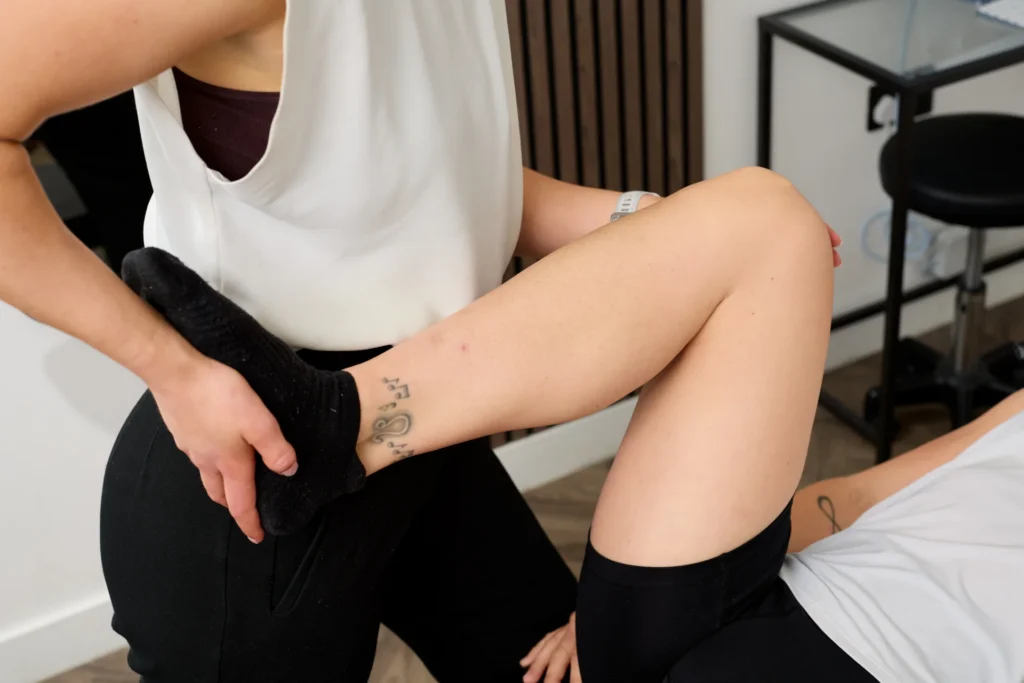

What Causes Knee Pain?
The knee is a complex joint that relies on muscles, tendons and ligaments working together to support movement and stability.
Common causes of knee pain include:
- Sudden increases in activity or training
- Repetitive movements such as running or squatting
- Muscle weakness or imbalance
- Poor movement patterns or technique
- Tendon irritation or overload
- Degenerative changes such as arthritis
In many cases, knee pain develops gradually due to changes in load or movement over time.
Common Knee Conditions We Treat
At Salford City Clinic, we regularly assess and treat a range of knee conditions.
Patellofemoral Pain Syndrome (PFPS)
PFPS is a common cause of pain around or behind the kneecap. It is often aggravated by activities such as squatting, lunging, running or prolonged sitting.
Contributing factors may include:
- Increased load through the knee joint
- Muscle imbalances, particularly in the quadriceps and glutes
- Reduced flexibility in surrounding muscles
Treatment focuses on improving strength, movement control and reducing aggravating factors.
Iliotibial Band Syndrome (ITB Syndrome)
ITB syndrome is a frequent cause of pain on the outside of the knee, particularly in runners.
It develops when the iliotibial band, a thick band of tissue along the outside of the leg, becomes tight and irritated.
Common symptoms include:
- Pain on the outer knee during activity
- Symptoms that worsen with running
- Stiffness around the knee
Treatment involves improving biomechanics, reducing tension and strengthening key muscle groups.
Patellar Tendinopathy (Jumper’s Knee)
Patellar tendinopathy causes pain just below the kneecap and is often linked to repetitive loading, such as jumping or running.
It may present as:
- Localised pain below the kneecap
- Tenderness to touch
- Symptoms that worsen with activity
Management focuses on carefully progressing loading through a structured strengthening programme.
Symptoms of Knee Pain
Knee pain can present in a variety of ways depending on the underlying issue.
Common symptoms include:
- Pain around or within the knee joint
- Stiffness or reduced range of movement
- Swelling or tenderness
- Pain during activity or after exercise
- Difficulty with walking, stairs or sitting
If your symptoms are affecting your daily activities, assessment is recommended.
How We Treat Knee Pain
Your treatment will be tailored to your specific diagnosis and goals.
Depending on your needs, your care plan may include:
- Physiotherapy to improve strength and movement
- Chiropractic care to support joint function
- Sports massage to reduce muscle tension
- Exercise therapy to improve stability and control
- Movement and technique correction
For persistent tendon-related pain, treatments such as radial shockwave therapy may also be recommended.
What to Expect at Your First Appointment
Your initial consultation is designed to identify the cause of your symptoms and provide a clear plan.
During your appointment:
- A detailed history of your symptoms will be taken
- A physical assessment of your shoulder will be carried out
- Pain is afYour diagnosis will be explained clearlyfecting your daily activities
- A personalised treatment plan will be created
You will also receive advice on how to manage your symptoms between sessions.
When Should You Seek Treatment?
You should consider seeking professional advice if:
- Your knee pain is not improving
- Symptoms are worsening over time
- Pain is affecting sleep or daily activities
- You have reduced movement or weakness
- Pain started following an injury
Early assessment can help prevent symptoms from becoming more long-term.
Benefits of Treatment
With the right approach, most knee conditions can improve significantly.
Treatment can help you:
- Reduce pain and irritation
- Improve movement and flexibility
- Restore strength and function
- Return to normal activities
- Reduce the risk of recurrence
Our aim is to help you move confidently and without limitation.
Why Choose Salford City Clinic?
- Award-winning clinic recognised by The Royal College of Chiropractors
- Experienced team of chiropractors and physiotherapists
- Evidence-informed care following NICE guidelines
- Personalised treatment plans tailored to your needs
- Integrated approach combining hands-on care and exercise
- Convenient Salford location with free parking
We focus on identifying and treating the cause of your knee pain.

Frequently Asked Questions
How long does knee pain take to improve?
This depends on the cause and severity. Many cases improve with structured rehabilitation, although tendon and joint conditions can take longer.
Do I need a scan?
Most knee conditions can be diagnosed through a clinical assessment without imaging.
Should I stop exercising?
Not always. In many cases, activity can be modified rather than stopped completely. Your clinician will guide you.
Can knee pain come back?
It can if underlying strength or movement issues are not addressed. We focus on long-term prevention.


Book Your Knee Pain Assessment in Salford
If you are experiencing knee pain and want clear answers and effective treatment, our team is here to help.
Book your appointment today at Salford City Clinic and take the first step towards reducing pain, improving movement and returning to your normal activities.